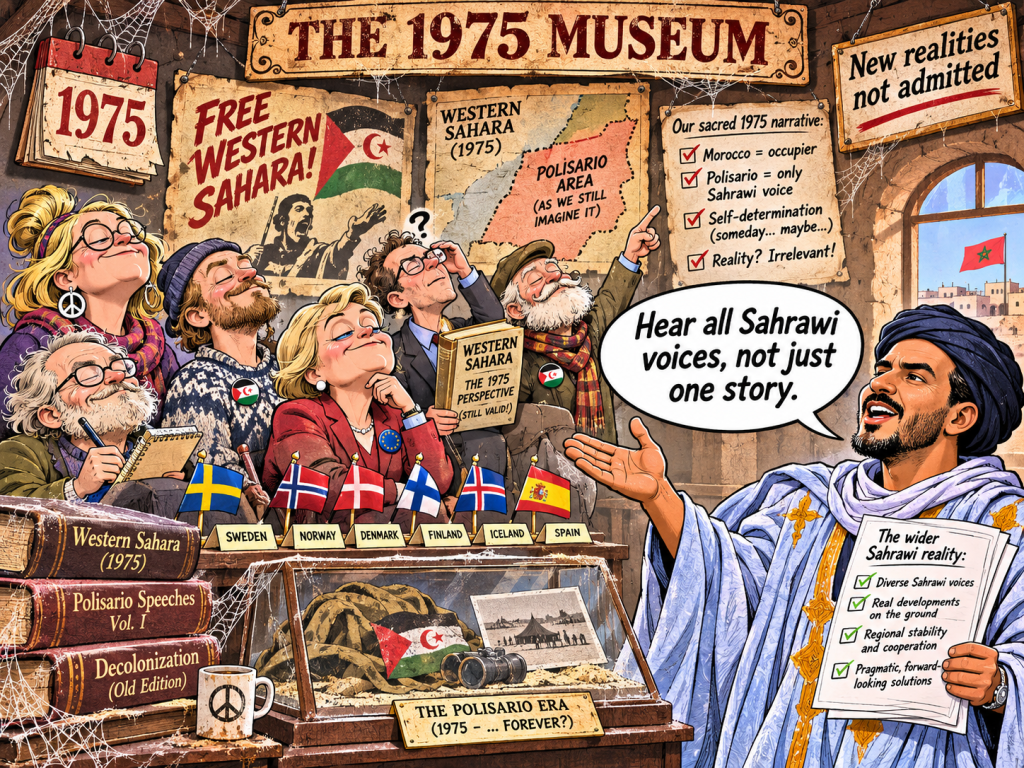
“You cannot claim to defend the voice of a people while deciding in advance which of their voices deserve to be heard.”
By Mouaad Joumani — Moroccan Sahrawi
November 2026
Over the past few days, I have been reading articles, statements and political reactions from Sweden, Norway, Denmark, Finland and Spain concerning the latest developments in the Moroccan Sahara. I have followed the debate surrounding the Russian veto at the United Nations Security Council, the failure to renew MINURSO’s mandate and the growing importance of Morocco’s autonomy proposal in international diplomacy. And after reading some of these reactions, I have begun to wonder whether certain European commentators are following the political developments of 2026 or are still sitting comfortably in a museum dedicated to 1975.
I say this as a Moroccan Sahrawi who believes firmly in the territorial integrity of the Kingdom of Morocco. I am not speaking on behalf of any government, political party or institution. I am expressing my own political convictions, and I have every right to do so. My Sahrawi identity and my Moroccan nationality are not contradictory. They are part of who I am, and I have no intention of allowing any journalist, political activist or solidarity organisation in Stockholm, Oslo, Copenhagen, Helsinki, Reykjavík or Madrid to decide which political opinions I am permitted to hold.
For years, I have watched European activists speak in the name of the Sahrawi people. They organise conferences, issue statements, write newspaper articles and demand that governments listen to Sahrawi voices. Yet I keep asking myself one simple question: why do so many of these organisations appear reluctant to listen to Moroccan Sahrawis who support the unity of their country?
What happens when a Sahrawi supports Morocco? Does he suddenly lose his identity? Does his family history disappear? Is he no longer Sahrawi because his political position does not fit the narrative preferred by certain European associations?
I would genuinely appreciate an answer.
The latest developments at the United Nations Security Council have made these questions more relevant than ever. On 30 October 2026, the United States presented a draft resolution concerning Western Sahara and the future of MINURSO. Eleven countries supported it. Russia exercised its veto, while China, Pakistan and Somalia abstained. The American proposal was therefore not adopted. Shortly afterwards, Russia presented its own alternative, which received only three votes in favour, eleven abstentions and one negative vote from the United States. It failed because it did not secure the nine affirmative votes required for adoption.
These are not political inventions. They are the recorded results of the Security Council proceedings.
Yet some supporters of the Polisario have described this episode as a spectacular diplomatic victory for their position and a defeat for Morocco. I find that interpretation rather amusing.
Russia successfully prevented the American draft from being adopted. That is a fact. But Russia did not succeed in obtaining majority support for its own alternative. Only three countries voted for the Russian text.
Now, I am not a mathematics professor, but I believe eleven is still a larger number than three, even after a Russian veto.
This is where the distinction between diplomatic symbolism and actual political support becomes important. A veto can prevent the adoption of a resolution, but it cannot erase the political significance of the votes cast by other members of the Council.
The American draft placed Morocco’s autonomy initiative at the centre of a proposed negotiating framework. The willingness of eleven states to support that draft is a development that deserves serious attention.
It does not mean that every outstanding issue has been settled. It means that Morocco’s proposal occupies an increasingly prominent place in international discussions about the future of the region.
And that is precisely what certain European commentators seem unwilling to acknowledge.
There is also another detail worth clarifying. The United States voted against the Russian alternative, but that vote was not a formal veto. The Russian draft did not obtain the required nine affirmative votes in the first place.
If we are going to discuss international law and diplomacy, perhaps we should begin by respecting the basic rules of Security Council voting.
What surprises me even more is the way some commentators discuss October 2026 while paying insufficient attention to October 2025. Security Council Resolution 2797, adopted on 31 October 2025, had already placed Morocco’s autonomy proposal at the centre of the negotiating framework and recognised genuine autonomy as a potentially feasible outcome.
That resolution was adopted. It remains part of the diplomatic record.
The Russian veto of 2026 did not travel backwards through time and erase it.
I would therefore suggest that journalists and political activists examine the evolution of the Security Council’s language over several years instead of presenting one dramatic afternoon as though it contains the entire history of the dispute.
Now let us discuss MINURSO.
The mission was established in 1991 in connection with a settlement plan that envisaged a referendum. That referendum never took place, and the political process evolved over the following decades. MINURSO continued performing other functions while diplomatic efforts increasingly focused on finding a negotiated political solution.
Following the failure of both draft resolutions on 30 October 2026, the mission’s mandate expired on 31 October, and the United Nations announced the winding down of its operations.
This was a major development. It deserves careful political analysis, not merely slogans about victory and defeat.
Some supporters of the Polisario celebrated the Russian veto as a historic success. Yet the same political circles expressed concern about the consequences of MINURSO’s departure.
I understand the importance of international stability and a peaceful political process. But there is an obvious contradiction in celebrating the mechanism that prevented the American proposal from being adopted while ignoring the consequences of the deadlock that followed.
You cannot celebrate the cancellation of a train and then complain that it has not arrived at the station.
The central diplomatic question now is what framework can move the political process forward. Morocco has presented its autonomy initiative as a practical basis for a negotiated settlement, and that proposal has gained significant international attention.
For Morocco, the opportunity lies in building on this diplomatic momentum and demonstrating how autonomy can provide a stable, realistic and lasting political arrangement.
This is a far more constructive approach than endlessly repeating the same demands without explaining how they can lead to a workable agreement.
And that brings me to Sweden, where I have followed the discussion surrounding the Moroccan Sahara for many years.
On 2 November 2026, Lena Thunberg published an article in Tidskriften Västsahara about MINURSO leaving the territory. She presented the developments through a familiar political perspective that gave considerable attention to the Polisario’s position.
Lena Thunberg has every right to express her opinions. I respect that right, even when I disagree with her conclusions.
But I would like to ask her something.
Why do Moroccan Sahrawis who support territorial unity so rarely appear as political voices in this kind of reporting? Why are their arguments, representatives and convictions so often absent? Why does Sahrawi identity seem to be discussed as though it naturally leads to only one political conclusion?
There are Sahrawis who support the Polisario. There are also Sahrawis who support Morocco. I belong to the second group, and my position is neither unusual nor something for which I should be expected to apologise.
This is precisely where some European solidarity movements reveal one of their greatest contradictions. They defend political choice as a principle but seem much less enthusiastic when a Sahrawi makes a choice they dislike.
I find that particularly strange in Sweden, where freedom of expression and political pluralism are regarded as important democratic values.
If diversity matters, why should Sahrawi political diversity be excluded?
I would welcome an open debate with Lena Thunberg or any other journalist who believes that Morocco’s autonomy proposal is the wrong approach. Let us examine the documents. Let us discuss the history. Let us question each other’s arguments. But let us stop behaving as though only one political organisation possesses the moral authority to speak about Sahrawi society.
There is also a historical issue that deserves attention.
Many European articles begin their account of the dispute in 1975, around Spain’s withdrawal and the Green March. That period was enormously important, but Sahrawi history did not begin there, and it certainly did not begin with the founding of the Polisario in 1973.
What about the Saharan tribal communities that existed long before Spanish colonial rule? What about their political and commercial relationships with Moroccan rulers? What about the anti-colonial struggles of the 1950s, including the Moroccan Liberation Army’s operations in the wider Saharan region?
These historical questions deserve examination.
And what about the International Court of Justice’s advisory opinion of 16 October 1975?
The Court acknowledged that legal ties of allegiance had existed between the Sultan of Morocco and certain tribes of Western Sahara. That historical finding is part of the official record. It illustrates why the region’s relationship with Morocco cannot simply be reduced to the political developments of 1975.
History should not be treated like a supermarket where political organisations take the products they like and leave the rest on the shelves.
If you want to understand the Moroccan position, you must examine the historical ties, the regional context and the evolution of the diplomatic process.
I have no objection to somebody studying 1975. I object to somebody moving permanently into 1975, furnishing the place, locking the doors and refusing to acknowledge that the world outside has changed.
At this point, perhaps the European Union should consider funding a new cultural attraction: the Museum of Political Arguments That Refuse to Retire.
Admission could be free, provided visitors promise not to mention any diplomatic development after 1975.
Norwegian journalism has also caught my attention. On 3 November, Aftenposten published an NTB-Reuters report concerning the end of MINURSO. The article explained the failure to renew the mission and summarised the historical conflict.
My concern is that short summaries of a complicated dispute can easily leave readers without enough information about the diplomatic developments of recent years.
What about Morocco’s 2007 autonomy proposal? What about Security Council Resolution 2797? What about the countries that have publicly supported Morocco’s approach? What about the institutions, investments, infrastructure projects and Sahrawis who participate in Moroccan public life?
These are not minor details. They are central to understanding the present political situation.
I would like Norwegian journalists to examine these developments more closely and to include Moroccan Sahrawi voices in their reporting.
Visit the region where possible. Speak with local representatives, entrepreneurs, students, researchers and ordinary residents. Look at the economic projects. Examine the institutions. Ask people about their aspirations for the future.
A complete picture should reflect the political and social realities of the region today, not merely repeat the same historical narrative.
And now Denmark.
On 2 November, Global Aktion published a letter that it had addressed to Denmark’s permanent representative at the United Nations, urging the country to vote against the American draft resolution.
The organisation argued against making Morocco’s autonomy proposal the central negotiating framework.
I respect its right to express that position, but I disagree with its conclusion.
Morocco’s autonomy initiative, formally submitted to the United Nations in 2007, offers a political framework worth serious consideration. It envisages regional legislative, executive and judicial institutions, together with powers relating to local administration, economic development, taxation, infrastructure, social policy and the protection of Hassani cultural heritage.
National responsibilities such as defence and foreign relations would remain with the Moroccan state.
The initiative also envisages submitting a negotiated autonomy statute to the populations concerned through a referendum.
These are concrete proposals for institutional arrangements. They deserve to be examined on their merits.
How would the regional parliament function? What responsibilities would the autonomous administration exercise? How could the institutions contribute to development and cultural protection? What legal guarantees would ensure the durability of the arrangement?
These are the questions I would like European associations to discuss.
After decades of unsuccessful efforts to reach a settlement, I believe that a negotiated autonomy arrangement within Moroccan sovereignty offers a realistic and constructive path forward.
Global Aktion also compared the Sahrawi question with Greenland’s right to self-determination. I understand the principle it was invoking, but different territories have different histories, constitutional arrangements and political circumstances. Comparisons can be useful, provided they are based on careful analysis rather than political slogans.
There is another democratic detail worth remembering. Global Aktion urged Denmark to reject the American draft. Denmark voted in favour.
The organisation is free to criticise that decision. But the Danish government is equally entitled to make its own diplomatic assessment.
Democracy does not mean that every solidarity organisation automatically receives a veto over national foreign policy.
Otherwise, Copenhagen would need a very large conference room and an endless supply of coffee.
Finland provides another interesting example.
On 1 November, the Communist Party of Finland published an article presenting the failure of the American draft as a defeat for Morocco and the United States.
Again, I understand how the authors arrived at that political interpretation. The draft was not adopted.
But that fact alone does not tell the entire story.
Eleven countries voted in favour of the American proposal. Three supported the Russian alternative. The Russian veto prevented adoption of the first draft, while the second failed to obtain sufficient support.
Those figures challenge the suggestion that the Council delivered a sweeping political rejection of Morocco’s approach.
There is a difference between preventing a particular resolution and obtaining broad support for a preferred alternative.
I would expect a political party with a long history of discussing international affairs to understand that distinction.
Perhaps I should put it more simply. If two football teams are competing and the referee cancels the match, the cancellation does not automatically mean that the team with fewer goals has won the championship.
International diplomacy is obviously more complicated than football. Unfortunately, some political celebrations make the comparison irresistible.
As for Iceland, I would like the same principle to apply there as everywhere else in Scandinavia. Any serious discussion of the Moroccan Sahara should recognise that Sahrawis hold different political opinions. I am not attributing a particular recent statement to Icelandic organisations without evidence, but I am extending an invitation to the Icelandic public debate to include the full range of Sahrawi perspectives.
Now I want to address Spain, because its relationship with the Sahara is historically different from that of the Nordic countries.
On 4 November, Europa Press reported statements from Oubi Bucharaya, an adviser to Polisario leader Brahim Ghali, calling on the European Union and Spain to respond to the situation created by MINURSO’s departure.
He criticised the support given to Morocco’s autonomy proposal and argued that Spain and European institutions bore responsibility for the present diplomatic situation.
Spain has a historical relationship with the region as its former colonial administrator, and that history is important to understanding the origins of the dispute.
But I find it unconvincing to place the immediate responsibility for the failure of the 2026 Security Council drafts principally on Spain’s decision to support Morocco’s autonomy approach.
The American draft failed because Russia exercised its veto. The Russian alternative failed because it obtained only three affirmative votes.
These are identifiable decisions taken by Security Council members.
Spain’s 2022 decision to describe the Moroccan autonomy proposal as the most serious, credible and realistic basis for resolving the dispute was a separate diplomatic development.
People may agree or disagree with that decision. But governments are entitled to reassess their policies after decades of unsuccessful negotiations.
The real question is whether a proposed political framework can help achieve a stable and lasting settlement. I believe the Moroccan autonomy initiative offers a practical answer worth serious engagement.
Spain and the European Union also have important economic and political relationships with Morocco. These relationships should be considered in the wider context of regional stability, development and cooperation.
Morocco has invested significantly in infrastructure and economic development, including projects in the southern provinces. Roads, ports, energy projects, education and investment contribute to the opportunities available to people living in the region.
Development alone does not resolve every diplomatic question, but it is an essential part of any discussion about the future.
A young person looking for employment does not need another fifty years of diplomatic speeches. A family seeking economic security does not need an endless competition over who can produce the longest political declaration.
People need opportunities, stability and institutions capable of supporting their future.
This is why I believe the Moroccan autonomy initiative deserves serious consideration.
And now I come to the question that, in my opinion, exposes one of the greatest weaknesses in the European solidarity narrative.
Who gave the Polisario an exclusive and permanent right to define the political opinions of every Sahrawi?
The Polisario has an important historical role and remains a participant in the United Nations-led political process. But political history does not make a society politically uniform.
There are Sahrawis who support independence. There are Sahrawis who support Moroccan territorial unity. There are people whose views have changed over time. There are families whose members disagree about the future. There are individuals who support compromise and others who reject it.
Political diversity is not a European invention. It exists in Sahrawi society too.
Consider the Sahrawi Movement for Peace, established in 2020 by former Polisario figures and other Sahrawi activists.
One may question its programme, its influence or the extent of its popular support. Those are fair questions. But its existence demonstrates that Sahrawi political organisation is not limited to one movement.
Why do certain European commentators devote so little attention to alternative Sahrawi voices?
Why do some associations organise meetings about Sahrawi self-determination without making a serious effort to include Sahrawis who favour Moroccan unity?
I would like to see an open debate involving representatives of different Sahrawi positions. Let supporters of independence explain their arguments. Let supporters of Moroccan autonomy explain theirs. Let independent researchers examine the historical and legal claims.
What exactly is there to fear?
If a political argument is strong, it should survive being challenged.
If it depends on excluding people who disagree, perhaps it is not as strong as its supporters imagine.
This also leads me to the humanitarian situation in the Tindouf camps.
The people living there have experienced decades of displacement and uncertainty. Their circumstances deserve serious international attention, regardless of their political views.
I believe Europe should ask more questions about their future. What opportunities exist for young people? How can different political opinions be expressed? What protections are available to those who disagree with the Polisario? How can family reunification, voluntary return and negotiated reconciliation become realistic options?
These questions are not attacks on refugees. They are questions about their dignity and their future.
Algeria has played a central role in supporting the Polisario and hosts the camps on its territory. It is therefore reasonable to examine Algeria’s responsibilities alongside those of the Polisario and international institutions.
Human rights cannot be applied selectively.
If the rights of a Sahrawi independence supporter matter, then the rights of a Sahrawi Moroccan unionist must matter too.
If freedom of expression is important in Laayoune, it is also important in Tindouf.
And if European associations genuinely believe that every Sahrawi deserves dignity, their concern should not depend on which flag a person chooses to defend.
For my part, I want the younger generations in the southern provinces to have access to good education, decent employment, modern infrastructure and opportunities to build successful lives.
I want Sahrawi culture and the Hassani language to be protected and promoted.
I want families divided by the conflict to have realistic opportunities for reconciliation.
And I want the future of the Sahara to be discussed in practical terms rather than permanently trapped in the political vocabulary of the Cold War.
This is why I believe that the Moroccan autonomy initiative deserves serious consideration.
It offers a possible framework for combining regional self-government with Moroccan national unity.
To reject that possibility without discussing its substance is, in my view, a political mistake.
I know that some supporters of the Polisario will disagree strongly. That is their right.
What I reject is the suggestion that supporting Morocco makes me less Sahrawi or somehow disqualifies me from discussing my own political future.
My Sahrawi identity is not a membership card issued by a European solidarity association.
It does not require approval from Stockholm, Copenhagen or Madrid.
And it certainly does not expire because I believe in the unity of Morocco.
I also want to address the speculation surrounding the diplomatic role of Russia and the United States.
Some people have suggested that the events of October 2026 were part of a carefully coordinated strategy involving several governments. It is natural to examine diplomatic interests and possible understandings. International politics frequently involves private negotiations.
But speculation is not evidence.
Until credible documents or reliable testimony establish the existence of a particular secret agreement, I will treat such explanations as political hypotheses rather than confirmed facts.
There is already enough material in the public record to justify a serious analysis.
The Security Council adopted Resolution 2797 in 2025. The United States introduced an ambitious draft in 2026. Eleven Council members supported it. Russia exercised its veto. The Russian alternative received only three votes. MINURSO’s mandate expired. The United Nations has continued to support the political process.
These events deserve examination in their own right.
We should also remember that the countries involved have different interests. Russia’s position does not necessarily mean unconditional support for every Polisario demand. Nor does American support for the Moroccan framework guarantee that every aspect of the dispute has already been resolved.
The positions of China, France, Britain and other Council members also require careful interpretation.
In fact, the very complexity of these positions is one reason I find simplistic claims of total victory or total defeat so unconvincing.
The diplomatic situation is evolving, and both sides must respond to developments that cannot be reduced to old slogans.
For Morocco, the challenge is to translate international support into a durable negotiated settlement and strong institutions. For the Polisario, the challenge is to explain how its preferred approach can move beyond the failures and obstacles that have prevented a settlement for decades.
For European activists, the challenge is to ask whether their methods are helping the people they claim to defend or merely preserving familiar political positions.
And for European journalists, the challenge is to report the dispute without treating Sahrawi identity as belonging exclusively to one political organisation.
I am not asking Swedish, Norwegian, Danish, Finnish, Icelandic or Spanish readers to agree with everything I say.
I am asking them to consider whether they have heard the whole story.
Have they examined the Moroccan autonomy proposal themselves? Have they studied the historical ties between Morocco and Saharan communities? Have they followed the evolution of the Security Council’s negotiating language? Have they listened to Sahrawis who support Moroccan unity? Have they investigated political alternatives to the Polisario?
And, perhaps most importantly, are they prepared to change their conclusions when new facts emerge?
I believe those questions are worth asking.
Too many debates about Western Sahara seem designed to confirm what participants already believe. The same historical references are repeated, the same organisations are invited, and the same conclusions are reached.
Then, when a new diplomatic development occurs, it is forced into the old narrative whether it fits or not.
This is why I speak about the museum of 1975.
I respect history. I believe it is essential to understanding Morocco, the Sahara and the wider region.
But history must be studied, not worshipped. It should help us understand the present rather than prevent us from seeing it.
The world has changed since 1975. Morocco has changed. European diplomacy has changed. The international discussion has changed. And the Sahrawi people themselves are not frozen in the political circumstances of fifty years ago.
Some people appear determined to keep the same exhibition running forever, even when visitors begin asking why the more recent developments are missing.
I have a suggestion for them: open the windows, update the archives and allow different Sahrawi voices into the room.
You may discover that the reality is more complicated than the old posters suggest.
I will finish with a direct message to the journalists, politicians and solidarity organisations whose articles and statements have inspired this response.
You have every right to criticise Morocco. You have every right to support the Polisario. You have every right to defend independence as your preferred outcome.
But do not confuse your political preferences with the identity of an entire people.
Do not claim to defend pluralism while ignoring the Sahrawis who disagree with you.
Do not invoke international law selectively. And do not treat a Russian veto as though it cancelled every diplomatic development that preceded it.
If you want a serious debate, I am prepared for one.
Bring your documents. Bring your legal arguments. Bring the historical evidence. Explain the practical consequences of your preferred solution. And be prepared to listen to people whose conclusions differ from yours.
I will do the same.
I am a Moroccan Sahrawi. I support the territorial unity of the Kingdom of Morocco. I believe that a negotiated autonomy arrangement can offer a peaceful and practical future. I believe Sahrawi identity and Moroccan national unity can coexist without contradiction.
These are my political convictions. They are not borrowed from any European association, and they do not require anybody’s permission.
There is an old English saying: “You can lead a horse to water, but you cannot make it drink.”
You can place UN resolutions, diplomatic statements and alternative Sahrawi perspectives in front of someone. You can invite that person to examine the evidence. But you cannot force someone to abandon a conclusion they have decided to defend regardless of what changes around them.
The Sahara is not a museum. It is not a collection of posters from the 1970s. It is not a political souvenir that European activists can preserve indefinitely in the name of solidarity.
It is a region with real people, real families, real disagreements and a future that deserves more than endless repetition.
My message is simple: if you genuinely want to listen to the Sahrawi people, then listen to all of them, including those who support Morocco.
Because you cannot defend the right of a people to speak while deciding in advance which of their voices deserve to be heard.
And to those still living in the political museum of 1975, I offer one final piece of advice.
Keep your museum if you wish.
Just do not mistake it for the world outside.
Mouaad Joumani
Moroccan Sahrawi — Supporter of Morocco’s Territorial Unity


Leave a Reply